NVIDIA Liquid Cooling Analysis – From Blackwell to Rubin
At the start of 2026, NVIDIA officially announced the full-scale mass production of its next-generation Vera Rubin AI computing platform at the CES exhibition. The changes in liquid cooling are significant and have garnered widespread attention. This article analyzes the evolution of liquid cooling solutions, shifts in value volume, and the supply chain landscape.
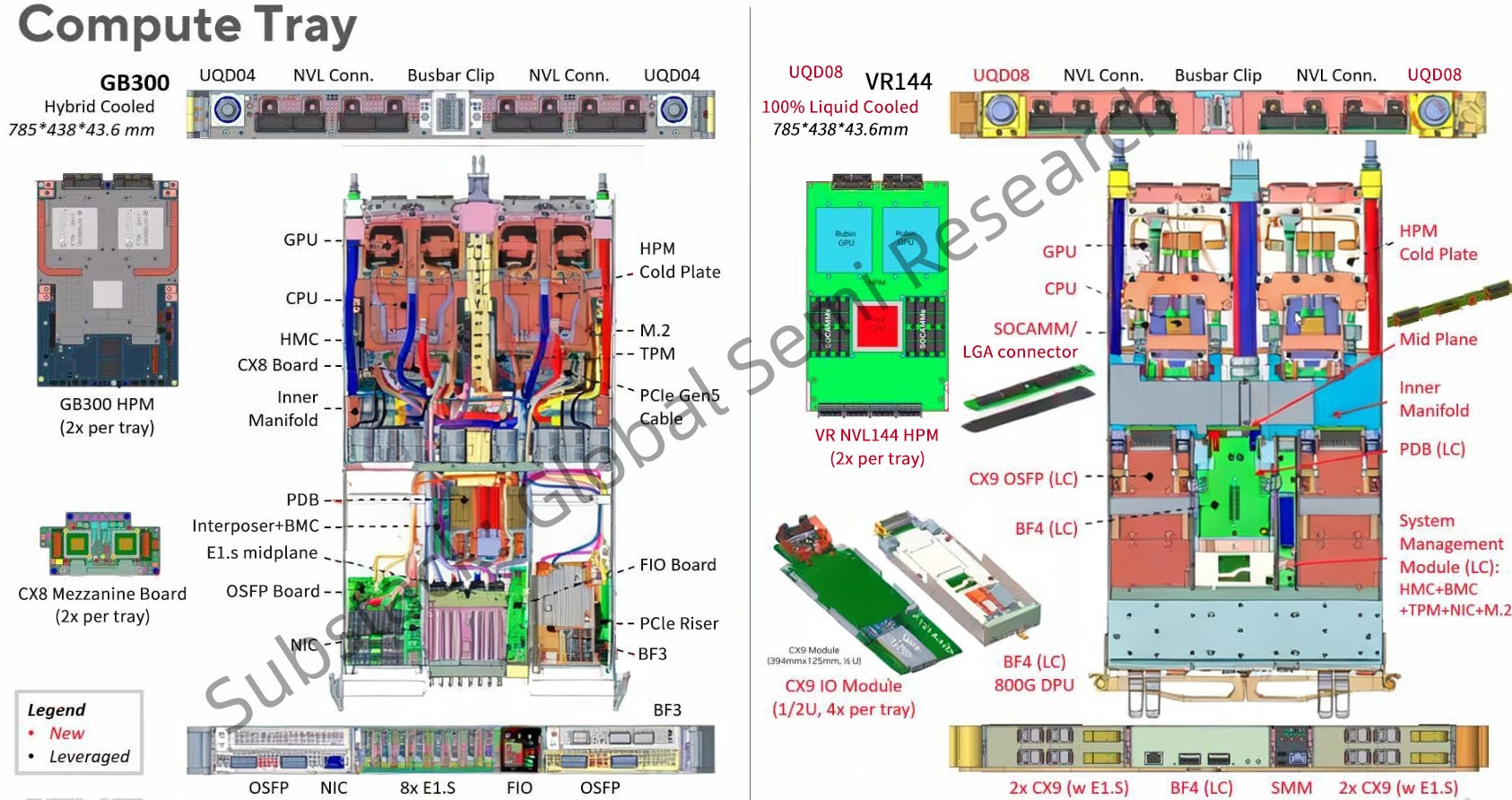
I. Upgrades to Liquid Cooling Solutions
Faced with the surge in GPU power consumption from 1000W for the GB200 to 2.3kW for Rubin, NVIDIA has achieved a leapfrog improvement in heat dissipation capabilities through four core upgrades:
1. 100% Liquid Cooling Coverage
Previously, the liquid cooling coverage of the GB200 was only 70%-80%, with critical components such as power supplies still relying on air cooling; the GB300 saw improvements but did not achieve full coverage.
There’s a lesser-known fact about the GB200’s liquid cooling worth mentioning. I originally thought that all GB200 servers (Compute trays and switch trays) were liquid-cooled, but this is not the case. The NVL36 x 2 remained air-cooled for the most part, and it was only in the later NVL72 models that liquid cooling solutions were gradually introduced. Surprising, isn’t it? Because NVIDIA’s official images of the GB200 compute tray all showcase liquid cooling setups.
The Rubin platform innovatively moves the power modules out of the integrated cabinet to create an independent POWER RACK, achieving 100% liquid cooling coverage for the first time. Combined with a cable-free, fanless modular design, it builds an integrated cabinet-level thermal management ecosystem characterized by “precision temperature control + high-efficiency heat exchange”. This breakthrough not only addresses heat dissipation blind spots for high-power chips but also significantly reduces cabinet air volume requirements (a reduction of 80% compared to the GB300), further improving energy efficiency.
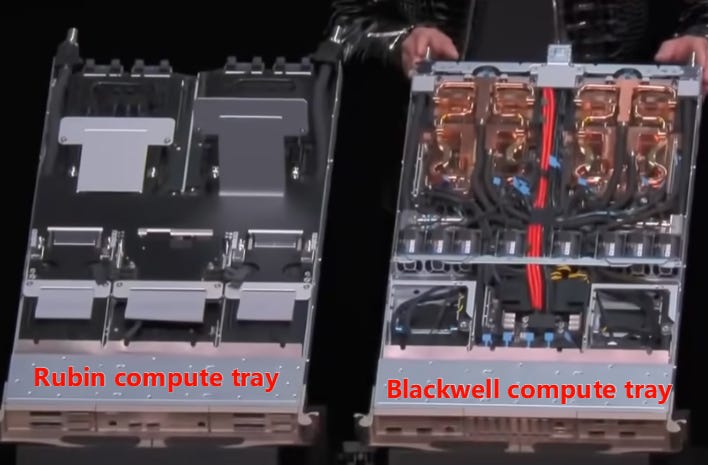
2. Return and Upgrade of Cold Plate Design
The GB200 adopted an integrated liquid cold plate, with two large cold plates in each Compute tray.
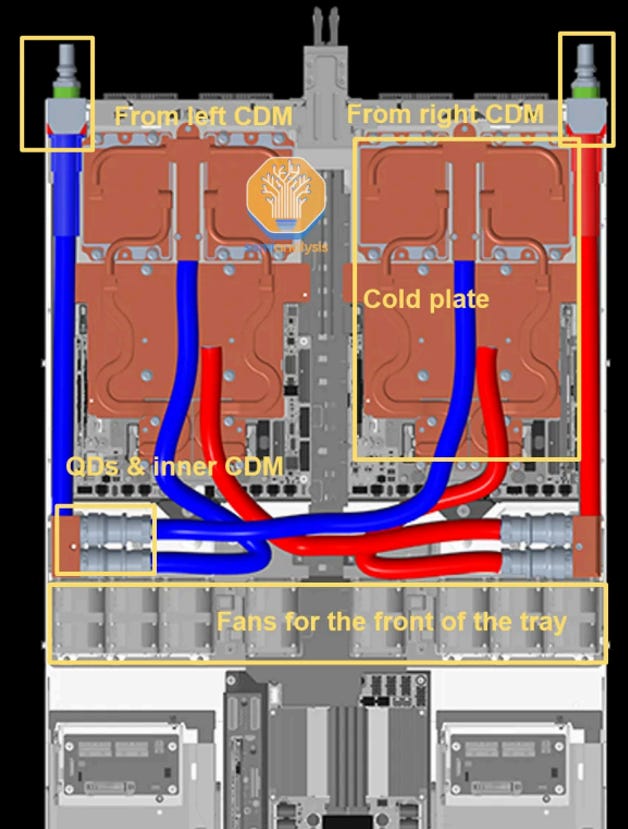
The GB300 shifted to independent small cold plates – meaning two B300 GPUs and the Grace CPU each had their own dedicated small cold plates, resulting in 6 small cold plates per Compute Tray. While this enhanced targeted heat dissipation, it led to a surge in the number of adapters and minifolds, significantly increasing the risk of liquid leakage. Rubin returns to a large cold plate design per Compute tray, while introducing microchannel technology in the area corresponding to each GPU – nanoscale flow channels are fabricated via laser welding, concentrating water flow and increasing its velocity to balance heat dissipation efficiency with simplified connections.
